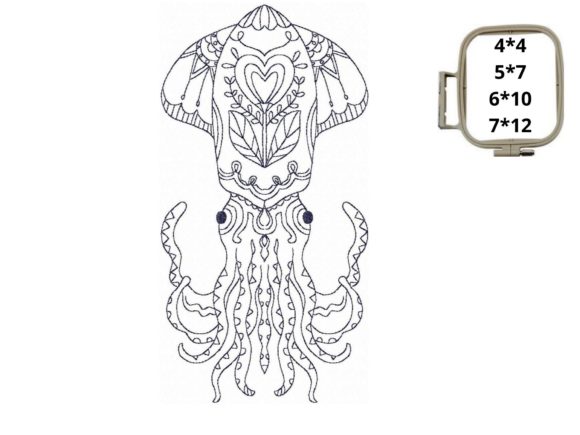
Squid: A Playful, Practical Line-Art Embroidery Design
As someone who’s stitched hundreds of designs across apparel, home goods, and boutique merchandise, I opened Squid expecting charm—and got clarity. This isn’t a fussy ocean motif with swirling tentacles and dense fills. It’s clean, confident line art: a single, fluid squid silhouette, balanced in proportion, with subtle curvature and intentional negative space. It feels like summer breeze—not deep-sea drama. That simplicity is its superpower.
First Impressions: Why Squid Fits Real Projects (Not Just Mockups)
I tested Squid on a natural linen tote bag for a coastal-themed pop-up shop. No embellishment, no color blocking—just the design centered on the front panel in navy thread. The result? Instant recognition, zero visual noise. Customers paused, smiled, and asked, “Is that hand-drawn?” That’s the line-art effect working: it reads as intentional, human-made, not clip-art. It carries personality without demanding attention—perfect for small business branding where subtlety builds trust.
The shape itself is smartly scaled. Not too tall to overwhelm a baby onesie, not too narrow to vanish on a sweatshirt chest. Tentacle curves are generous enough to stitch cleanly on stretchy cotton jersey but avoid tight corners that snag or skip. And because it’s line-based—not an applique design or heavy fill-stitch illustration—it avoids bulk on lightweight fabrics like chambray tea towels or gauzy nursery pillows.
Where Squid Shines (and Where It Needs Thought)
Squid excels in contexts where authenticity matters more than flash:
- Custom apparel: Works beautifully on crewneck sweatshirts (left chest), relaxed-fit t-shirts (back yoke), and even curved surfaces like bucket hats—provided you use light cutaway stabilizer and slow your machine speed slightly on the outer curve.
- Handmade product lines: As a embroidered patch, it transfers cleanly onto denim jackets or canvas aprons. Its open structure means less thread buildup, so patches lie flat and survive repeated washes.
- Personalized gifts: Paired with a simple monogram or date on a beach towel or baby blanket, Squid adds thematic warmth without competing visually.
- Etsy seller & small shop product: It photographs well in natural light, scales nicely in digital embroidery file previews, and reads clearly in printable mockups—even at thumbnail size.
But let’s be practical: this isn’t a one-size-fits-all embroidery file. On ultra-thin silk or heavily textured bouclé, the fine lines can blur or float. On dark fabric, contrast depends entirely on your thread colors—test navy on black twill, yes, but also try ecru on charcoal for softer appeal. And while it’s labeled “easy to stitch,” don’t skip the stabilizer step on knits; even light tear-away won’t cut it for long runs on t-shirt blanks.
What It Does for Your Craft Business (Beyond Aesthetics)
As a designer reviewing Squid for commercial embroidery, I looked beyond prettiness—I asked: does this raise perceived value? Does it support brand consistency? Does it convert?
Yes, yes, and yes—but only when used intentionally. Because it’s line art, it pairs effortlessly with minimalist typography or complementary motifs (think tiny starfish or wave accents). That makes it a flexible design asset—not just a standalone embroidery project, but part of a cohesive collection. For Etsy sellers bundling digital embroidery files, Squid fits naturally into “Ocean Life” or “Summer Essentials” sets alongside coordinating seashell or anchor designs.
It also builds customer trust. Busy parents buying embroidered baby items notice clean stitching. Boutique buyers scanning Instagram feeds respond to uncluttered, confident shapes. And because Squid avoids over-engineered details, it stitches reliably across machine types—fewer re-hooping moments, fewer thread breaks, less frustration during batch production.
Designer Notes You’ll Actually Use
Before cutting fabric or listing on your shop:
- Test on scrap first—especially if using textured or stretchy fabric. Watch how the outermost tentacle tips land.
- Check stitch density. Line-art doesn’t mean low stitch count—some versions include subtle satin-stitch accents. If yours does, confirm it’s not overly dense for your fabric weight.
- Confirm hoop size. While compact, Squid may still require a 4x4” minimum. Don’t assume it fits a 3x3” hoop without verifying.
- Inspect small details in your embroidery software. Are any connecting points overly thin? Can your machine handle them at full speed?
- Mock it up in black and white—not just color. See how legible it is on light vs. dark backgrounds before committing to thread.
- Use proper stabilizer. Light cutaway for knits, tear-away for stable wovens, and fusible + tear-away for lightweight linens.
- Review licensing. Since Squid is marketed for t-shirts and beach items, confirm whether your intended use—like selling finished embroidered patches or bundling as part of a craft kit—falls within permitted commercial embroidery terms.
Final Thought: Squid Isn’t Just Cute—It’s Considered
This isn’t a novelty fish embroidery design tossed into a “Fish” category because it has fins. Squid earns its place through thoughtful construction: rhythm in the line, breathing room in the layout, adaptability across fabric types, and quiet confidence in its theme. It works on a holiday gift tag and a wholesale apron line. It reads as handmade, not mass-produced. And for creative entrepreneurs building real businesses—not just weekend projects—it delivers what matters most: reliability, resonance, and repeat appeal.
If you’re choosing between ten ocean-themed embroidery files for your next craft fair lineup or Etsy refresh, Squid isn’t the flashiest. But it might just be the one that sells out first—because customers don’t just buy a squid. They buy summer ease, coastal calm, and the quiet assurance that something well-designed was made just for them.